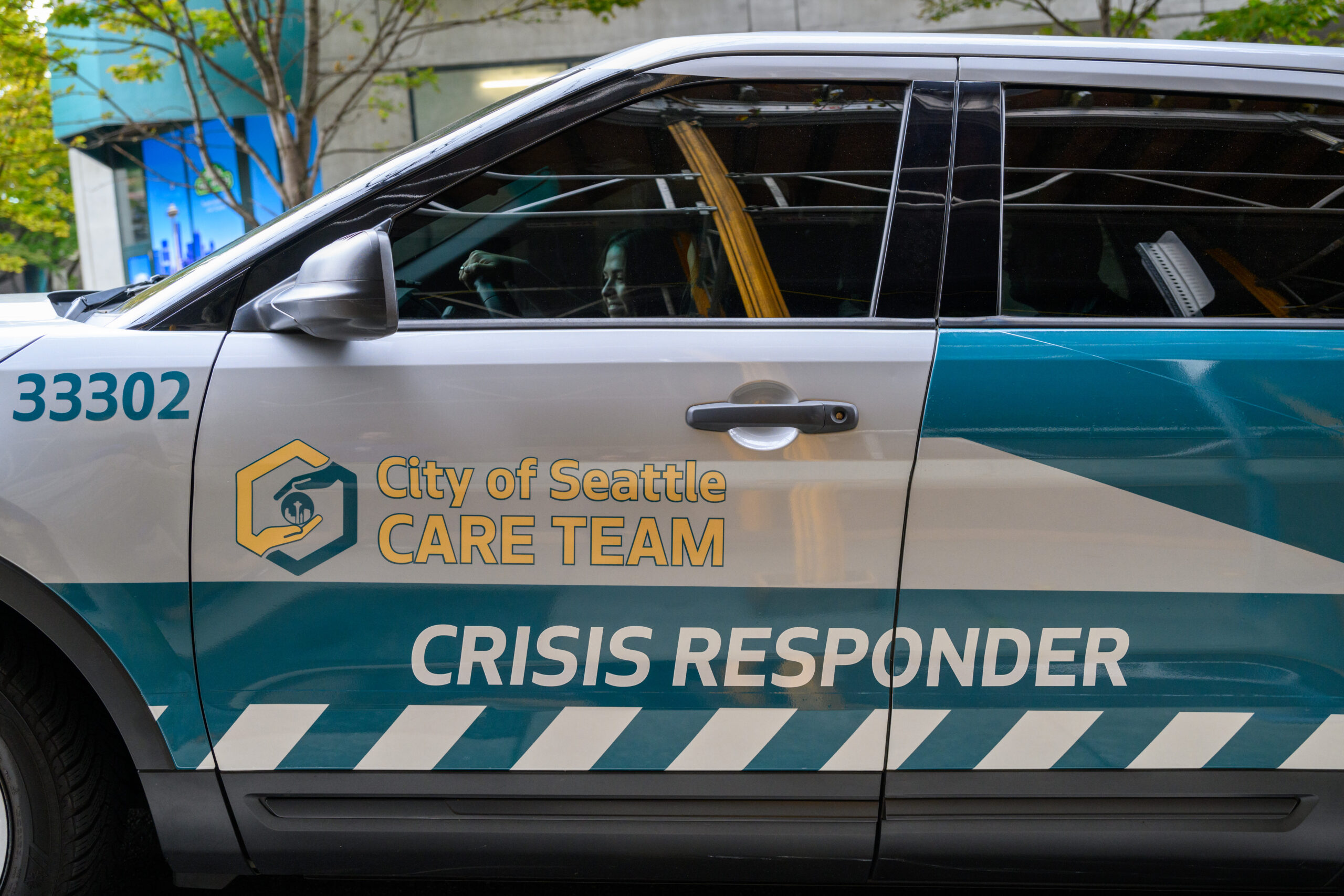
Under a new police contract negotiated by Mayor Harrell’s administration, Seattle’s CARE Department crisis response teams will permanently expand beyond the limited pilot that launched in October 2023 and continue shifting the public safety paradigm.
New contract strengthens accountability with 180-day investigation timeline resolution, provides dual language and education incentives in the spirit of the 2017 accountability ordinance, paves the way for significant reform through arbitration, and allows for the civilianization of more SPD positions.
Seattle – Today, Mayor Bruce Harrell announced a tentative collective bargaining agreement (CBA) reached with rank-and-file Seattle police officers, allowing for the expansion and direct dispatch of CARE crisis responders, improving accountability with civilian investigators, and streamlining of the disciplinary process. The contract covers salaries and working conditions for 2024, 2025, 2026, and 2027.
“This groundbreaking agreement with rank-and-file officers represents a pivotal moment in our efforts to reimagine the public safety paradigm – unlocking the full potential of the CARE Department model by allowing responders to directly dispatch to thousands of emergency calls while removing staffing limitations. We’re also strengthening police accountability by allowing civilian investigators to work on cases involving potential termination and streamlining disciplinary processes to address misconduct swiftly and appropriately,” said Mayor Harrell. “This contract supports our officers work to address crime and delivers on our promise to create a comprehensive, diversified public safety system that protects every neighborhood in Seattle.”
Key elements of the agreement:
- CARE – Removes limitations on CARE Community Crisis Responder (CCR) staffing, which was previously capped at 24, expands the types of incidents CCRs can be dispatched to, and authorizes CCRs to be solo dispatched to low-acuity 9-1-1 calls.
- Discipline Timeline Calculation – Aligns contract language for how disciplinary process timelines are calculated and tracked with the 2017 Accountability Ordinance, addressing a key priority for accountability entities, the federal monitor, and U.S. District Court Judge James Robart.
- Investigation Improvements – Establishes a process within SPD to ensure supervisors are responsible for and able to address minor performance and misconduct issues in a timely and effective manner. Empowers the Office of Police Accountability to assign civilian investigators as co-lead investigators on cases involving potential termination.
- Staffing and Recruiting – Updates wages and benefits to ensure Seattle remains competitive in hiring new officers among West Coast states, an area of the country where 78% of SPD applicants come from. Builds on positive recruitment trends and incentivizes bachelor’s and associate degrees and language proficiency. Increases civilianization within SPD’s backgrounding and recruiting unit.
“This expanded agreement between the City and SPOG is the most significant milestone since the CARE responder pilot launched two years ago, and I commend Mayor Harrell for keeping diversified response a top and unequivocal priority,” said CARE Chief Amy Barden. “Going forward, we will finally be able to predictably and consistently send the best first response to a 911 call — something our community has demanded and deserves. Further, law enforcement officers can now be significantly freed up to respond to high priority police calls. The CARE Department represents a movement of both pragmatism and compassion. We work at the intersection of behavioral health and criminal justice, and recognize that when both systems are adequately equipped and designed to rehabilitate and redirect individual lives, our City will be transformed. Today we are one step closer to that vision. I express my personal gratitude to the countless neighbors and community groups who have cheered and advocated and insisted we can do better. And, we all owe a debt of gratitude to those members of the Seattle Police Department who boldly supported the CARE responders from day one.”
Building on the over 5,000 events CARE responders went to in 2025, the City will now be able to send CCRs as the primary dispatch for 9-1-1 calls related to reports of a person in a behavioral health crisis; requests for shelter, food, or transportation resources; and reports of a person who appears to be in a physical state that needs to be checked on for their safety. There is also an expanded list of emergency calls CCRs can be dual dispatched to alongside police, including person down with drug use; welfare checks with drug use; and certain lower priority nuisance calls.
“During its pilot phase, we have seen the promise of this new and innovative model of alternative unarmed response, and we can now proudly move CARE into its next phase as the largest city in the country advancing this model,” said Mayor Harrell. “Creating CARE in the first place – and now expanding it – has required difficult labor negotiations, but we have been unwavering in our focus to unlock the full potential of the CARE crisis response teams. Put simply, this new agreement means more people experiencing behavioral health crises will receive the help they need from a trained CARE Crisis Responder, dispatched directly by 9-1-1. This will lead to healthier people, safer streets, and a better city.”
Under the agreement, police officers will receive a retroactive pay increase of 6% for 2024 and 4.1% for 2025. Officers will get an additional 2.7% increase in 2026, and the 2027 increase will range from 3% to 4%, depending on the Consumer Price Index. The costs associated with this CBA are within the anticipated budget projections for the department and does not add to the City’s deficit.
In addition to changes to base wages for officers, starting in January 2026, the agreement will introduce education premiums of 1.5% for relevant associate’s degrees and 4% for bachelor’s degrees, as well as a 1.5% premium for bilingual language skills. The 2017 accountability ordinance, in Section 3.29.430(C), mandated the use of hiring preference points for officers with multilingual skills and education achievements needed in modern policing. This contract provides further incentives to enhance officer education achievements and multilingual skills.
“I commend Mayor Harrell for his tireless dedication in securing a collective bargaining agreement that not only strengthens support for our officers but also enhances public safety in Seattle. This agreement reflects our shared commitment to the community and ensures that the brave men and women of our police department can continue to serve with pride and dedication,” said Police Chief Shon Barnes. “This agreement also bolsters the department’s reputation as a competitive employer, which can empower us to build on this year’s positive recruitment efforts.”
Last week, members of the Seattle Police Officers Guild, which represents patrol officers, detectives and sergeants, voted to approve this new agreement. Next, the mayor will transmit the agreement to the City Council for their approval. This agreement updates the one previously reached in 2024 and will be in effect through December 31, 2027.
Throughout the collective bargaining process that began in 2024, the City sought changes to the discipline appeal process that is available to officers who are disciplined for violation of SPD rules and regulations. The new agreement resulted in an impasse on proposals to revise the process for the review of discipline matters. The City and SPOG will now proceed with a statutory process that ends with an interest arbitrator resolving whether the City’s proposed changes will be included in the CBA.
What People Are Saying
Councilmember Bob Kettle, District 7, Public Safety Committee Chair
“The labor agreement reached with the Seattle Police Officers Guild is an important step in achieving our objectives for public safety and bolsters our hard-fought work over the last two years to create a safe base in our city. This agreement will assist us in reaching our police department staffing goals, and further the city’s alternative response aims by including sole dispatch of CARE (Community Assisted Response and Engagement) responders. This in turn, frees up police officers to respond to law enforcement emergencies. Our accountability goals are advanced with frontline investigations, which is key to developing future leaders in the police department.”
Council President Sara Nelson, Position 9
“Solo dispatch of CARE responders to 9-1-1 calls for people in crisis is the key to unlocking the CARE’s potential. This contract validates the years-long collaboration between City Council and Mayor Harrell’s administration and enables us to advance our promise of meaningful police reform to the people of Seattle.”
Councilmember Maritza Rivera, District 4
“This SPOG contract accomplishes three things: it makes us more competitive in our recruitment efforts and recognizes the hard work of our officers at the Department; it takes a large and important step toward our alternative policing goals; and brings much needed accountability measures that exemplify our progressive values.
I look forward to seeing the positive results from this new method of dispatch – both for our residents in need and our city as a whole. And I plan to continue working to bring accountability and transparency to policing in the City.”
Councilmember Dan Strauss, District 6
“This contract clears the roadblocks preventing CARE’s Community Crisis Responders from responding quickly and effectively to non-criminal emergencies. This means Seattle will be able to send the most appropriate resources to 911 calls faster, reducing response times, and freeing up police officers to focus on crime. Washington State law puts strict limits on what accountability reforms we can implement without bargaining to agreement. This contract takes a major step forward – winning important accountability provisions and moving us forward on others. Our work is far from done”
Lisa Judge, Inspector General, Office of Inspector General
“I am pleased with the significant progress made by the City in several core areas. This agreement opens the door to improved responses for community members in crisis, clears the way for front line investigations of minor misconduct, and clarifies disciplinary timelines so everyone understands the process. These gains reflect the thoughtful inclusion of accountability partner input in setting parameters and providing technical assistance throughout the negotiation process. When bargaining for the next contract begins, OIG will again make full authority and power to include issuance of subpoenas as a top bargaining priority as the city sets parameters. That said, this round of bargaining has moved the City forward on several key reforms important for accountability.”
Bonnie Glenn, Interim Director, Office of Police Accountability
“The Seattle Office of Police Accountability (OPA) finds the Tentative Agreement (TA) with the City of Seattle and the Seattle Police Officer’s Guild (SPOG) a significant progress in achieving our mission and values. This TA includes meaningful improvements for OPA’s operations and investigations, as well as the accountability system. Under the terms of this TA, OPA’s skilled civilian investigators can investigate a broader range of allegations, the Frontline Investigation process would be reinvigorated, and the 180day timeline would be simplified. These terms would more closely align the SPOG contract with the full vision of the 2017 Accountability Ordinance. Additionally, there are other innovative improvements for public safety in the TA to include expanding operations for the Community Assisted Response and Engagement (CARE) Department.”
Lisa Daugaard, Co-Executive Director, Purpose Dignity Action; former member and founding Co-Chair, Community Police Commission
“It’s wonderful to see the negotiated acknowledgment of the CARE Department as a core aspect of Seattle’s response to a wide range of public safety issues. At the same time, having worked for many years to improve our system of response to serious police performance and disciplinary issues when they occur, I am glad to see an ‘agree to disagree’ approach taken on points where principled agreement was not possible. Seattle leaders should always have been willing to declare an impasse on aspects of the accountability system, rather than claiming that contract terms matched up to the legislative promises of the 2017 Accountability Ordinance–I wish this approach had been taken by prior administrations. I appreciate the honesty of the current resolution. Finally, it’s great that SPD employees will be working under an updated, fairly negotiated, contract that honors their contributions and efforts.”
Erin Goodman, Executive Director, SODO Business Improvement Area, former CPC Co-Chair
“I congratulate the City of Seattle and the Seattle Police Officers Guild on reaching an agreement that provides officers with resources, fair salaries, and a reliable accountability process. This stability allows them to focus on their work with confidence, strengthening public safety across the city. A key element of this agreement is making the CARE Team a permanent first-response partner alongside SPD and SFD, building on Seattle’s history of innovation. From my experience in SODO, where public safety and human services challenges are complex, I’ve seen how critical it is to match the right responders to each situation. By laying the groundwork for a stable, well-supported police force and a trained civilian response team, this agreement delivers a safer, stronger community and city.”
Mike Stewart, Executive Director, Ballard Alliance
“The announcement of the new collective bargaining agreement is welcome news. Expanded access to CARE responders, including the ability for CARE responders to be dispatched independently, will go a long way toward addressing many of the crisis-related challenges we face on a daily basis in neighborhoods like Ballard.”
Chris Leverson, Executive Director, Build Lake City Together
“Expanding the CARE Team and enabling direct dispatch ensures a more focused, compassionate response for those in crisis. Lake City needs the presence of CARE Team members, along with continued City support for our business and residents. Community safety is necessary for community well-being.”