
Felony enforcement, paired with significant public health investments in post-overdose, detox, and treatment services, has contributed to an 18% reduction in overdose deaths so far this year.
Seattle—Today, Mayor Bruce Harrell and Seattle Police Chief Shon Barnes announced a significant increase in drug trafficking case prosecutions through the first three quarters of 2025, an increase of 42% compared to the full-year 2024 total.
Arrests by SPD have resulted in 193 felony drug trafficking cases charged by the King County Prosecuting Attorney’s Office through September 2025 – 57 more cases than all of 2024. Roughly 70% of the cases involve fentanyl, methamphetamine, or both. As many as 20% of the cases also involve a charge of unlawful possession of a firearm because the defendant has a criminal history that prohibits their possession of a gun.
“Our comprehensive approach to the fentanyl crisis is showing real results, helping keep our neighborhoods safe. We are aggressively targeting and arresting the drug traffickers and dealers who bring these deadly poisons into our city, and I am grateful for our strong partnership with King County prosecutors in holding offenders accountable,” said Mayor Harrell. “At the same time, we are investing significantly in treatment and recovery services because we know that addiction is a disease that requires help and treatment. This balanced strategy ensures we are responding with both the urgency and the tailored approach this crisis demands, creating a safer and healthier Seattle for all.”
KCPAO charged felony drug trafficking cases from SPD referrals:
| Year | Cases |
| 2025 (through September) | 193 |
| Full Year 2024 | 136 |
| Full Year 2023 | 177 |
| Full Year 2022 | 152 |
| Full Year 2021 | 80 |
In September, KCPAO announced that multiple felony charges were made in a case of suspected drug dealing resulting from an SPD investigation. The suspected drug dealing involved large amounts of fentanyl, meth, and cocaine and the investigation resulted in the recovery of $30,000, a .45 caliber handgun, and a .22 caliber rifle.
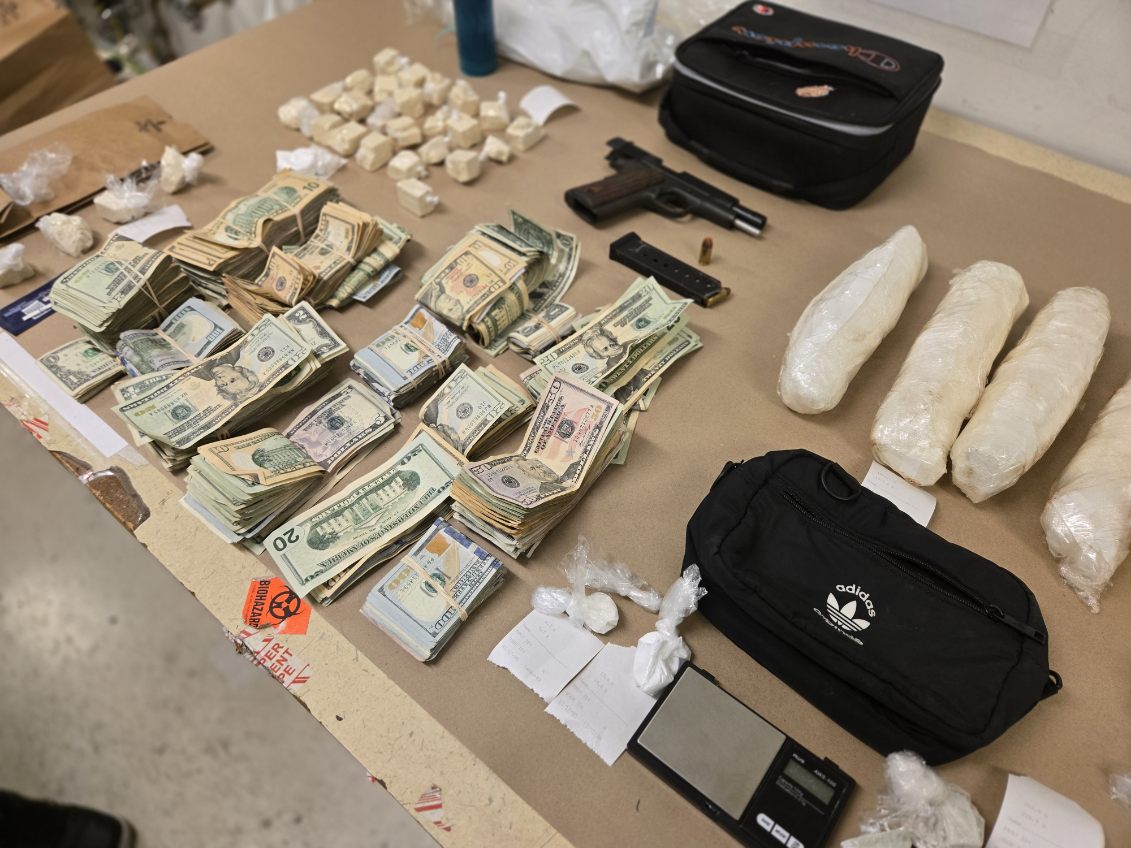
Photo by Seattle Police Department, showing drugs, cash, and a gun seized as evidence
“Reducing the flow of illegal drugs in Seattle is critical to making the city as safe and welcoming as it can be for residents, workers, and visitors from the region and beyond,” said Police Chief Barnes. “That’s why I’m proud of the high-impact work that the women and men of the Seattle Police Department are doing with our partners to get illegal drugs off the city’s streets. The criminals out there should know that if they break the law, we will arrest them.”
Under KCPAO’s filing and disposition standards for drug dealing offenses, “[p]ossession with intent to deliver should be charged only where specific independent evidence exists to clearly and convincingly establish the requisite intent. Examples of such evidence include quantity far in excess of personal use amounts, multiple packages, presence of paraphernalia associated with dealing such as scales or multiple empty packages, possession of large amounts of currency, customer records or observations by the police of hand-to-hand transactions between the suspect and others.”
“I appreciate the good work and partnership of the Seattle Police Department in removing deadly drugs like fentanyl from our streets,” said King County Prosecuting Attorney Leesa Manion. “The people charged with drug dealing by the King County Prosecuting Attorney’s Office are preying upon on our King County communities – the drug dealers we charge often possess enough fentanyl to kill hundreds if not thousands of King County residents. We will continue to work hand in hand with our law enforcement partners to hold drug dealers accountable for distributing drugs such as fentanyl in our communities.”
These felony drug trafficking enforcement actions are being paired with significant City investments to support those with substance use disorders. Last month, Mayor Bruce Harrell announced his $40 million funding proposal that includes investments in the City’s post-overdose response, detox, and treatment programs, building on the plan and investments Mayor Harrell launched in 2023.
The proposal increases the Seattle Fire Department’s (SFD) post-overdose response team, known as Health 99, by $1.6 million to add staffing and fund an ambulance and van to transport patients and conduct follow-up visits with clients served by the Mobile Integrated Health program. Last month, SFD announced that its Firefighter/EMTs reached the milestone of administering buprenorphine at its 100th patient encounter in the field – after launching the first in the nation pilot program last year to administer this medication. Currently, SFD responds to more than 45 patients per week experiencing an opioid overdose across the city and Health 99 has responded to more than 1,630 overdoses since it launched in July 2023.
The proposal also includes $2.9 million specifically for detox and treatment services anticipated to be available through a funding process next year and builds off lessons learned from recent City funded pilot treatment programs. Additionally, $1.8 million will go towards the Thunderbird Treatment Center, a new state of the art 92-bed treatment center on Vashon Island operated by Seattle Indian Health Board. These investments are in addition to $6 million in 2026, a 23% funding increase over 2025, for treatment related programing through the City’s service contract with Public Health – Seattle & King County.
In August, DESC’s Opioid Recovery & Care Access (ORCA) Center opened downtown to provide 24/7 post-overdose stabilization services for up to eight people at a time, supported by a $3.37 million capital funding investment by the City utilizing funding from U.S. Department of Housing and Urban Development’s Community Development Block Grant Program. This program was part of a $27 million investment supporting Mayor Harrell’s Executive Order 2023-04: Addressing the Opioid and Synthetic Drug Crisis in Seattle, announced as part of the Downtown Activation Plan to create a safe, welcoming downtown.
As of October 24, 2025, overdose deaths in Seattle are down 18% compared to 2024 and down 41% compared to 2023, according to King County Medical Examiner’s Office data.
What People Are Saying
Councilmember Bob Kettle (District 7), Chair of the Public Safety Committee
“This increase in felony drug trafficking charges shows the collaborative progress the city and county have made in creating a safer Seattle. The Council’s strategic approach to public safety – using legal tools to combat felony crime, investing in drug treatment services and the CARE team to address public health, and working to create a more functional criminal justice system – is paying off. More work remains, and we are committed to continuing these efforts to support our impacted communities.”
Chief Harold Scoggins, Seattle Fire Department
“Seattle firefighter/EMTs and paramedics continue to respond multiple times per day across the city to people experiencing overdoses. Our Post Overdose Response Unit (Health 99) has proven to be a successful fire department model towards a public health approach of helping those in our community who are battling addiction. The personnel who staff Health 99 aim to connect overdose survivors with medications for opioid use disorder, primary care and other supportive services. Our team administers buprenorphine medication in the field, which temporarily stabilizes patients and provides short-term relief from withdrawal symptoms to allow our responders to better engage in conversations around treatment, recovery and social services.”
Jon Scholes, President & CEO, Downtown Seattle Association
“Under the leadership of Mayor Harrell and Chief Barnes, there’s an increased emphasis on intervention and interruption to combat the fentanyl crisis on our streets. We’re seeing more officers on foot and bike in the heart of downtown, and a multi-faceted approach to a set of circumstances that calls for accountability for those who are breaking the law and accessibility for those who need treatment. Continued progress on the drug crisis is critical for a healthy and vibrant downtown Seattle for all.”
Don Blakeney, Executive Director, U District Partnership
“From the heartbreaking toll of addiction that deepened during the pandemic to the violence fueled by entrenched drug markets, our neighborhoods have felt the real effects of the drug crisis. The increase in enforcement and expanded treatment options are important steps toward making a difference on the ground in our neighborhoods.”
Erin Goodman, Executive Director, SODO Business Improvement Area (BIA)
“The SODO BIA is encouraged to see results from a strategy that tackles both sides of this crisis — stopping large-scale trafficking while expanding the care and treatment options that save lives. The reduction in overdose deaths this year is evidence that coordinated, compassionate enforcement works. We look forward to continued progress in SODO and beyond as a result of this important work. We thank Mayor Harrell, Chief Barnes, and City departments for leading with both accountability and humanity.”
Lisa Howard, Executive Director, Alliance For Pioneer Square
“This approach, with both access to treatment services and a focus on law enforcement, is what helps Pioneer Square. Addressing drug activity helps to ensure the community is safe and accessible for everyone – our office employees, our small businesses and their loyal clientele, and people visiting the neighborhood to shop, eat, or catch a game or concert.”